Just Had an Accident on I-80 in Fairfield? Do These 7 Things
Accidents on the I-80 corridor through Fairfield cluster in predictable places: the merge chaos at the Cordelia Junction, the slowdowns near Travis Boulevard and Air Base Parkway, and the grade toward Vacaville. If you’ve just been in one, here’s the order of operations, written for this stretch of road specifically.
1. Get out of the traffic lanes if you can
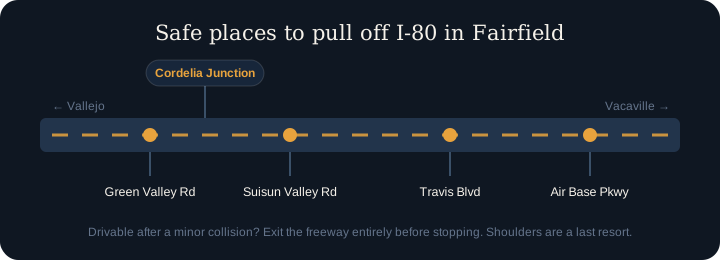
California law expects drivable vehicles in minor collisions to move out of the roadway. On this corridor that means the right shoulder, or better, off at the next exit: Green Valley Road, Suisun Valley Road, Travis Boulevard, and Air Base Parkway all have safe places to stop within a quarter mile of the freeway. Staying in a live lane after a fender-bender is how a small crash becomes a big one, especially near the Junction where traffic approaches from three directions.
If the car won’t move, stay inside with your seatbelt on and hazards flashing until help arrives. Do not stand between vehicles or on the traffic side.
2. Call 911 if anyone might be hurt
Any injury, even a “probably fine” one, means 911. On the freeway, CHP responds. Adrenaline masks injuries, so err toward reporting.
3. Exchange information, photograph everything
Driver’s license, insurance card, plate, and the other driver’s phone number. Then photos: all four corners of both cars, the wider scene showing lane positions, skid marks, debris, and the nearest exit sign or mile marker. On I-80 that location detail matters later, both for the insurance claim and for any tow dispatch.
4. Know how freeway tows work before agreeing to one
If CHP is on scene and your car is blocking traffic, they may order a rotation tow to clear the road quickly. You can’t refuse a tow ordered for traffic safety, but understand where that car goes: usually a storage yard that charges daily fees, not a body shop.
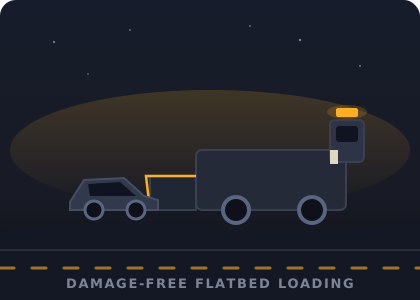
If your car is safely on the shoulder and not blocking anything, you generally choose your own tow and your own destination. Having it taken straight to a body shop you trust skips the storage yard entirely, which is the single biggest cost-saver in the whole process. If it already went to a yard, move it out as soon as you have the release; storage fees stack daily.
5. Tell your insurer the same day
Most policies require prompt reporting. Give them the photos, the other driver’s details, and the exact location. Ask two questions: where they want the vehicle inspected (push for your chosen shop, not the yard), and whether your policy reimburses towing, since most collision coverage does. Keep the tow receipt.
6. File the DMV SR-1 if it qualifies
California requires drivers to file an SR-1 report with the DMV within 10 days if anyone was injured or if property damage exceeds $1,000, which nearly any modern-bumper collision does. This is separate from the police report and separate from your insurance claim, and skipping it can put your license at risk. Your insurer or agent can help, but the legal duty is yours.
7. Watch for the after-effects
Soreness that shows up the next morning, a car that pulls slightly, a trunk that no longer seals. Document anything that emerges and tell your insurer and doctor. Claims stay open for exactly this reason.
The local shortcut
The difference between a bad afternoon and a bad month on this corridor usually comes down to one decision: where the car goes in the first hour. Shoulder to your shop, one tow, done. Shoulder to a yard to your shop is two tows plus daily storage plus paperwork.
If you’re on the corridor now and need a truck, Solano Towing dispatch answers 24/7 at (707) 356-ROAD, quotes one firm price, and delivers to the body shop of your choice anywhere from Fairfield to Vacaville.