Broke Down on the Bridge: What to Do
Three bridges carry traffic in and out of Solano County, and each of them is a bad place to stop. The Carquinez Bridge takes I-80 across the strait at Vallejo. The Benicia-Martinez Bridge carries I-680 out of Benicia. Highway 12 crosses the Sacramento River at Rio Vista on a lift span. Breaking down on any of them is a different situation from breaking down on an ordinary stretch of freeway, and the instincts that serve you elsewhere will get you hurt here.
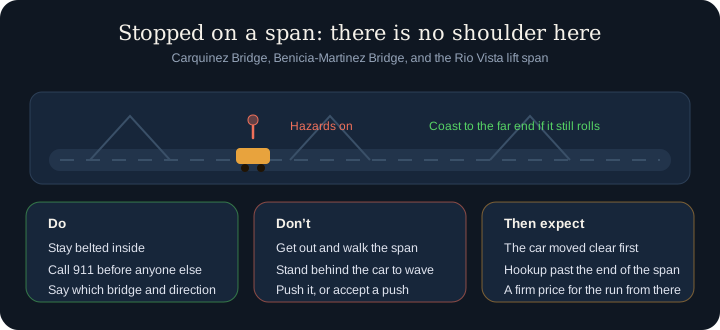
Keep rolling if the car will still roll
If the engine has died but the car is still moving, use it. Momentum across a span is worth more than a tidy stop. Hazards on, steer as far right as the structure allows, and aim to coast past the end of the bridge, where there is a shoulder, a vista point or a toll plaza apron and a truck can actually reach you.
Power steering and power brakes get heavy once the engine stops. Both still work, they simply need far more effort, so grip the wheel properly and press the brake hard rather than assuming it has failed.
If it stops on the span, stay inside
This is the part that matters most. On a bridge there is no shoulder to speak of, no embankment to stand behind, and nowhere to walk to. The barrier beside you is a few inches of concrete with a long drop on the other side, and the lane beside you carries traffic at freeway speed with limited room to move over.
Hazards on, seatbelt fastened, stay in the car and call. The only exception is the obvious one: fire or smoke, where you get out and away on the side away from traffic.
Do not walk off the bridge, in either direction, even if the end looks close. Do not stand in front of or behind your car to wave people off. And do not try to push it, with or without help from a passing driver.
Call 911 first, then a tow
On a bridge, the first call is 911. This is not a formality. The agencies that run these structures watch them, they can warn traffic, slow the lanes and get a unit to you quickly, and a stalled car on a span is treated as an urgent hazard rather than a routine breakdown. The California Highway Patrol handles the freeway bridges.
Expect your car to be moved off the structure before anything else happens. A tow truck cannot safely set up, hook and winch in a live lane with no shoulder, so the normal sequence is that the vehicle is pushed or shifted clear of the span first, to the apron or shoulder past the end, and the tow is done from there. If you call us from a bridge, that is exactly what we will tell you, and we will arrange to meet you where the car ends up.
Tell dispatch three things: which bridge, which direction, and roughly how far across you are. “Westbound on the Carquinez, about halfway” is enough to route a truck to the correct end, which matters, because the ends are in different counties.
Wind is the local hazard
The gap at the Carquinez Strait funnels wind, and it is strong enough on some afternoons to be a real factor for anything with a high side: vans, box trucks, trailers, bikes and anyone towing. If you are in one of those and the car in front of you is being pushed around, slow down before the span rather than on it, and keep both hands on the wheel. A trailer that starts swaying on a bridge has nowhere to go.
The same wind picks up over the delta at Rio Vista. It is the reason the wind turbines are on the Montezuma Hills, and the reason an empty trailer gets lively on the approach.
The Rio Vista bridge raises
One local detail worth knowing: the Highway 12 crossing at Rio Vista is a lift bridge. It goes up for river traffic, and when it does, road traffic stops and waits. That is normal, and it is not a breakdown.
Where this matters is in what you do while you sit. Leave the car in gear or park with the brake on, stay in your lane, and do not get out to look. When the span comes down the queue moves off quickly, and a driver standing beside an open door holds up both directions.
If your car genuinely dies while you are waiting in that queue, the rules above apply. Hazards on, stay inside, call, and let the bridge crew and the responders sort out traffic before anyone touches the car.
After it is off the bridge
Once the car is clear of the structure and on the shoulder, apron or vista point, a tow is an ordinary job again. From the Carquinez end, the natural destinations are shops in Vallejo or across the water. From the Benicia-Martinez Bridge, it is usually Benicia itself or up I-680 toward Fairfield. You get a firm price for the run before the truck moves, and if the car stopped because of overheating, a dead alternator or a fuel problem, say so, since that decides whether it rolls onto a flatbed or needs more care.
Stopped on a span right now? Call 911 first. Once the car is clear of the bridge, Solano Towing dispatch answers 24/7 at (707) 356-ROAD for the tow.