Car Overheating on I-80? What to Do Next
Solano County summers find every weak cooling system on the road. A run of 100-degree days, a sustained climb like the Vaca grade between Fairfield and Vacaville, stop-and-go at the Cordelia Junction, and the air conditioning working flat out. That combination pushes a marginal radiator, a tired water pump, or a low coolant level over the edge. What you do in the first minute after the gauge starts climbing decides whether you’re replacing a $40 hose or an engine.
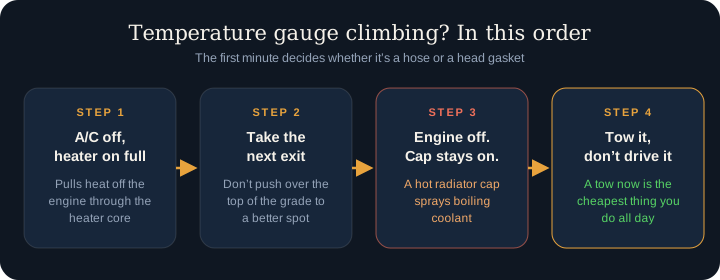
Step 1: A/C off, heater on full, even in July
It feels backwards, and it works. Your heater core is a small second radiator. Turning the heat to maximum with the fan on high pulls heat out of the coolant and dumps it into the cabin. At the same time, switching off the air conditioning removes the extra load the compressor puts on the engine.
Roll the windows down and put up with it for a few miles. It can buy you enough margin to reach an exit safely, and sometimes enough to bring the needle back down.
Step 2: Take the next exit, don’t push on
The instinct on a grade is to keep going to the top, or to a better exit, or to the gas station you know is three miles ahead. Don’t. Every minute an engine runs genuinely hot, the aluminum cylinder head is expanding and the head gasket is taking damage.
On I-80 through our area, the exits come frequently enough that there’s almost always one within a mile or two: Air Base Parkway, Travis Boulevard, North Texas, Cherry Glen, Alamo Drive. A parking lot off an exit is a far better place to deal with this than the freeway shoulder, where you’re standing a few feet from traffic doing 70.
If you genuinely can’t make an exit, get as far right as possible, put the hazards on, and stay belted inside the car unless you can get out on the passenger side behind a barrier.
Step 3: Engine off, and leave the radiator cap alone
This is the one that sends people to the emergency room. A cooling system under heat is pressurized, and the coolant inside is well above boiling. Twisting a hot radiator cap or the coolant reservoir cap releases that pressure all at once, and the coolant comes out as a spray of scalding liquid and steam, straight at your face and hands.
Leave every cap on until the engine has cooled for at least thirty minutes, and even then, cover it with a thick rag and turn it slowly. Better still, let someone with the right gear handle it.
If you see steam, don’t open the hood immediately either. Wait until it stops.
Step 4: If it actually overheated, tow it
Here’s the honest part. If the needle went into the red, or you saw steam, or a warning light came on, the car shouldn’t be driven further, even after it cools and the gauge reads normal again.
The reason is that overheating is usually a symptom, not the problem. Something let the coolant level drop or stopped it circulating: a split hose, a failed water pump, a stuck thermostat, a cracked radiator. That fault is still there after the engine cools. Drive off and the needle climbs again within a few miles, and the second overheat is the one that warps the head.
A tow to a shop at that point is genuinely the cheapest decision you’ll make all day.
Signs you’re heading toward it
Catch it early and you avoid the whole thing:
- The gauge sitting higher than normal. Most cars hold the needle dead center. If yours is drifting toward the top on hot days, something’s marginal.
- A sweet smell. Coolant has a distinctive syrupy smell. Smelling it inside the car or after parking usually means a leak.
- Puddles. Green, orange, or pink fluid under the front of the car is coolant.
- The A/C blowing warmer at idle. Some cars reduce A/C load automatically when the engine runs hot. It’s a subtle early warning.
- Low coolant in the overflow tank. Check it cold, with the engine off, once a month in summer.
Why Solano County is so hard on cooling systems
Two things stack up here. The first is heat: Vacaville and Fairfield regularly see multi-day stretches past 100°F, and the air your radiator is trying to shed heat into is already hot. The second is grade: the climb on I-80 between Fairfield and Vacaville is long enough and steady enough to load an engine continuously, where flat freeway driving would let it recover.
Add commuter traffic at the Junction (crawling in stop-and-go with the A/C running and little airflow through the radiator) and you have ideal conditions for a marginal system to fail. It’s why late July and August bring a noticeable spike in overheating calls.
What it costs
A tow from the Vaca grade or anywhere on I-80 in Solano County is a hook fee plus a per-mile rate, quoted as one firm number before the truck is dispatched, and it’s the same price at 3pm in 105-degree heat as at 3am. Have your direction of travel and the last exit you passed ready when you call.
Overheating right now? Solano Towing dispatch answers 24/7 at (707) 356-ROAD.