Car Won't Start in Fairfield? How to Tell Why
A car that won’t start is the single most common call we get in Fairfield, and a good share of them never need a tow truck at all. Before you pay for anything, the sound your car makes when you turn the key narrows the problem down to one of three parts. Here’s how to read it.
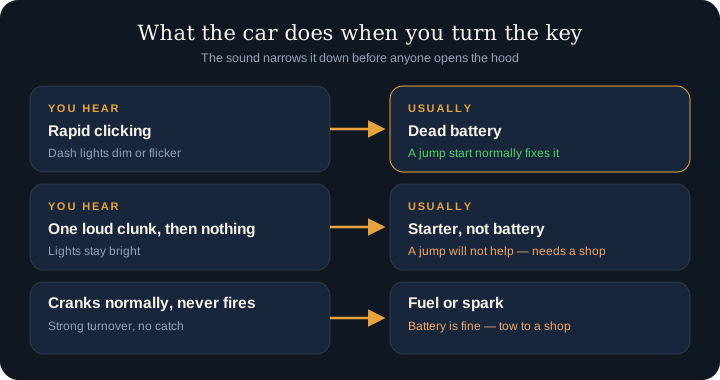
Rapid clicking: almost always the battery
That fast machine-gun clicking is the starter solenoid trying to engage and falling short on voltage. Look at your dash lights while you turn the key. If they dim noticeably or flicker in time with the clicking, the battery doesn’t have enough left to spin the engine.
This is the good outcome. A jump start gets you running in a couple of minutes, and around Fairfield it’s most of what our service trucks do: the Solano Town Center parking structure, the commuter lot at the Fairfield Transportation Center, and driveways off North Texas Street before an early shift.
One loud clunk and then silence: think starter
If you get a single heavy clunk and nothing follows, and your headlights and dash stay bright, the battery is probably fine. That’s usually the starter motor or its solenoid failing to turn the engine over.
The important part: a jump start will not fix this. If someone jumps you and it fires up, it was the battery after all. If a jump changes nothing, stop spending time on it. The car needs a shop, and that means a tow.
Cranks strongly but never catches: fuel or spark
If the engine turns over at normal speed (that healthy rurr-rurr-rurr) but never fires, your electrical system is doing its job. The problem is on the fuel or ignition side: a failed fuel pump, a clogged filter, a crank sensor, or a no-spark condition.
Nothing roadside fixes this either, and cranking repeatedly can flood the engine and drain a good battery on top of the original fault. Two or three honest attempts is plenty before you call.
The alternator: the one that strands you twice
The alternator recharges the battery while you drive. When it fails, the car runs off battery alone until there’s nothing left, then dies, often miles from where it started.
The tell is what happened before it quit: headlights dimming at idle and brightening when you rev, a battery warning light, or the radio and dash flickering. If you jump a car with a failing alternator, it will start and then strand you again a few miles down the road. That’s why our operators check that the alternator is actually charging before they leave, and say so plainly if it isn’t. A tow to a shop now is cheaper than a second call-out from the shoulder of I-80 tonight.
Why Solano County is hard on batteries
Batteries here get squeezed from both ends of the calendar. Vacaville and Fairfield summers run well past 100 degrees for stretches, and that heat evaporates electrolyte and shortens a battery’s life from the inside. The damage is done in July but doesn’t show up until later. Then the first cold, damp mornings off the Suisun Marsh in December demand the most cranking amps of the year from a battery that summer already weakened.
That’s why so many “it was fine yesterday” calls land on the first genuinely cold morning. If your battery is over three years old and has been cranking slowly, it’s telling you what’s coming.
Four things worth trying before you call
- Check the terminals. A loose or corroded connection mimics a dead battery exactly. If you can wiggle a cable clamp by hand, tighten it and try again.
- Turn everything off. Headlights, climate, radio, phone chargers. Give every remaining amp to the starter.
- On an automatic, try neutral. A worn safety switch sometimes won’t let the car start in park but will in neutral.
- Don’t keep cranking. More than a few attempts overheats the starter and finishes off a marginal battery.
What it costs, and what to have ready
A jump start in Fairfield, Suisun City, or Vacaville is a flat service-call fee, quoted before anyone is dispatched, and it’s the same rate at 3am as at 3pm. If the battery won’t hold or the alternator isn’t charging, you’ll get the tow price before the truck hooks up: hook fee plus mileage as one number.
When you call, have your location (a cross street or the parking row), the year, make and model, and, most usefully, what it does when you turn the key. That last detail is what tells dispatch whether to send a service truck or a tow truck, and getting it right the first time saves you a second wait.
Not starting right now? Solano Towing dispatch answers 24/7 at (707) 356-ROAD.