Stuck in a Ditch After Rain? What to Do
The first real rain of the season turns Solano County’s road shoulders to soup. The unpaved edges along Suisun Valley Road, Rockville Road, Highway 12 toward Rio Vista, and the farm roads out past Dixon soften fast, and every winter a steady stream of drivers find out how little it takes: one tire off the pavement, the ground gives, and the car settles into the ditch.
What happens in the next ten minutes usually decides whether this is a quick pull or a damaged car.
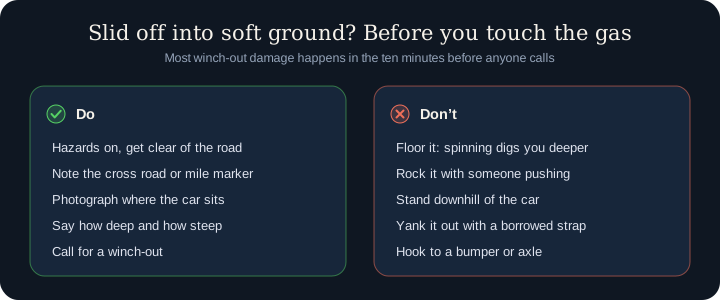
First: get safe
A car in a ditch is often sitting at an angle, partly in the path of traffic, on a rural road where nobody expects to find a stopped vehicle, frequently in rain and low light.
Put your hazards on. If it’s safe to get out, do so on the side away from traffic and move well clear of the car and the roadway. Don’t stand downhill of a car on a slope; soft ground can let it shift. If you can’t get out safely, stay belted in and call.
Don’t floor it
Every instinct says to give it gas and power out. On soft ground, that’s what makes a simple recovery difficult.
Spinning tires don’t find grip in mud. They dig. Each second of wheelspin carves a deeper rut, lowers the car further onto its underside, and packs mud around the wheels. A car that was sitting on its tires becomes a car sitting on its frame, and that’s a much harder, slower, more expensive pull.
One gentle attempt to ease out in low gear is reasonable. If the wheels spin without the car moving, stop immediately.
Don’t let someone push, and don’t use a borrowed strap
Rocking a car back and forth while a passenger pushes puts that person directly in the line of a car that can suddenly break free, and behind spinning tires throwing mud and rocks.
The borrowed tow strap and a friend’s pickup is the other classic. It feels like it should work. The problems are real ones: a pull at the wrong angle can bend suspension parts or drag the car sideways further into the ditch, and hooking to a bumper, an axle, or a suspension arm can rip parts off. A strap that isn’t rated for the load can snap and whip back with enough force to break glass or hurt someone.
Recovery gear is attached to the manufacturer’s designated recovery points and pulled in line with the vehicle for good reason.
What to tell dispatch
The details that get the right truck out the first time:
- Where you are. On rural roads that means a cross road, a nearby address, a winery or farm stand name, or a mile marker on Highway 12. “Somewhere on Suisun Valley Road” covers a lot of road.
- How the car is sitting. Level, or tipped at an angle? Nose-down in a ditch, or sideways on a bank?
- How deep. Just one tire off the pavement, or sunk past the axles?
- How far from solid ground. A few feet from the pavement, or down an embankment?
- Whether it’s damaged. Did it hit anything going in?
A photo helps enormously if you can send one.
How a winch-out actually works
The operator positions the truck on firm ground, assesses the angle and the footing, and runs a winch line to the vehicle’s recovery points. The pull is controlled and steady, nothing like the jerk of a strap, and done in line with the car so it comes out the way it went in.
For a car close to the pavement and sitting level, it’s often quick. Deeper situations take more: a car down a steep bank or sunk to the frame may need a snatch block to change the angle of pull, or a second anchor point, and more time to set up properly.
Once it’s back on solid ground, the operator checks the tires, wheels, suspension, and underside. If it’s drivable, you’re on your way. If something got damaged on the way in (a bent wheel, a torn tire, a cracked oil pan), the same truck can tow it, quoted as one job.
After you’re out
Even if the car drives fine, it’s worth a few checks over the next day:
- Pulling to one side or a new vibration can mean bent steering or suspension parts.
- Warning lights after a hard hit underneath deserve attention.
- Mud packed in the wheels can cause a vibration at speed. A car wash usually fixes it.
- Fluid spots in your driveway the next morning suggest something got damaged underneath.
What it costs
A simple pull near the pavement is usually a flat fee. Longer pulls, steep banks, or deep mud are quoted after a quick description on the phone, always before the truck rolls, so the number doesn’t change once the job starts.
Stuck right now? Solano Towing dispatch answers 24/7 at (707) 356-ROAD.