Can You Tow a Tesla or EV? What to Know
Electric vehicles break down less often than gas cars, but when they need a tow, the rules are different, and getting them wrong can turn a flat battery into a damaged drive unit. If you drive a Tesla, Rivian, Polestar, Chevy Bolt, Hyundai Ioniq, or any other EV around Fairfield and Vacaville, here’s what you need to know before the truck shows up.
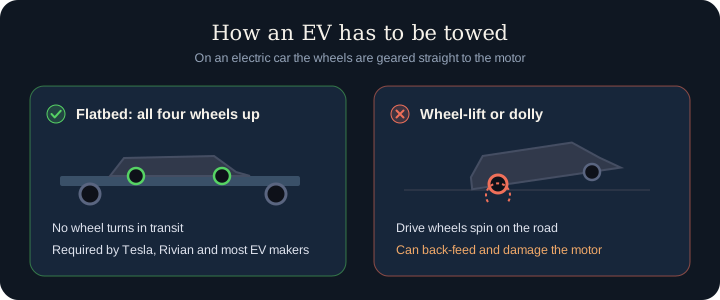
Why EVs have to ride on a flatbed
A gas car with an automatic transmission can sometimes be towed with two wheels on the ground, because putting it in neutral disconnects the engine from the wheels. Electric vehicles don’t work that way. On most EVs the wheels are geared directly to the electric motor, and there’s no true neutral that fully separates them.
Spin the drive wheels while the car is being towed and you spin the motor. A spinning electric motor acts as a generator, sending current back into a system that isn’t expecting it and building heat in a drive unit that isn’t being cooled. That’s the damage manufacturers warn about.
Which is why Tesla, Rivian, and essentially every EV maker specify the same thing: all four wheels off the ground, on a flatbed. Not a wheel-lift. Not a tow dolly. Not flat towing behind an RV.
Any tow operator who proposes lifting just one end of your EV should be politely told no. We dispatch flatbeds for every EV call by default, so you shouldn’t have to have that conversation.
Transport mode: do this before the truck arrives
Most EVs have a setting that disengages the parking brake and lets the car roll freely so it can be winched onto the flatbed. Teslas call it Transport Mode; other makers call it tow mode or neutral hold. It’s usually buried in the service or towing menu on the touchscreen, and on some cars it requires your foot on the brake while you select it.
Enable it just before the operator is ready to load, not twenty minutes ahead. On many models it cancels itself if the car goes to sleep or you walk away with the key. If you can’t find it, the operator can talk you through it; the major brands’ menus are familiar territory.
When the battery is completely dead
This is the tricky case. Transport mode needs power to engage, and an EV whose main battery is exhausted also often has a flat 12-volt battery, the small conventional battery that runs the computers, door locks, and brakes. With no 12-volt power, the car may not unlock, won’t respond to the screen, and won’t release its parking brake.
There are ways around it. Many EVs, including Teslas, have a hidden access point for jump-starting the 12-volt system just enough to wake the car, unlock it, and engage transport mode. When that isn’t possible, operators use wheel skates (small dollies placed under the locked wheels) or a winch-assisted load, so the car goes onto the deck without its wheels ever turning on the pavement.
Mention that the car is completely dead when you call so the right equipment is on the truck from the start.
”I just ran out of charge”: where to tow it
If your EV ran out of range, it usually doesn’t need a shop. It needs a charger. Around here, that often means a tow to the nearest DC fast charger (the Vacaville outlets area and the charging along the I-80 corridor are common destinations) or to your home if you have a wall connector.
Say which you want when you call. Towing a car that just needs electrons to a repair shop wastes your money and their time.
If it was in a collision, say so
A damaged EV battery is a different situation. If the car was in an accident, took a hard hit underneath, was in floodwater, or if you notice smoke, hissing, popping sounds, or an unusual smell from beneath the car, tell dispatch immediately and keep people away from the vehicle. Damaged lithium-ion batteries can heat up well after the incident.
Operators handle these calls with extra caution and keep the car on a flatbed, and in some cases the destination needs to be somewhere that can store a damaged EV safely rather than parked inside a shop.
What to have ready when you call
- Make, model, and year, and say it’s electric
- Where you are: cross street or direction plus last exit on I-80
- What’s wrong: out of charge, won’t wake up, collision, warning message
- Whether the car responds: does the screen turn on, do the doors unlock
- Where it’s going: home, charger, service center, or shop
What it costs
EV towing in Fairfield, Suisun City, and Vacaville is priced like any other tow: a hook fee plus mileage, quoted as one firm number before the truck rolls. The flatbed isn’t a premium add-on. It’s simply the correct equipment, and it’s what we send.
Stuck with an EV that won’t move? Solano Towing dispatch answers 24/7 at (707) 356-ROAD.