Towed by CHP in Solano County? How to Get Your Car Back
Few things ruin a week like walking out to where your car was and finding pavement. If your vehicle was towed in Fairfield, Suisun City, or Vacaville, the path to getting it back depends on who ordered the tow, and knowing that first will save you hours of phone calls.
Step 1: Figure out who ordered the tow
There are three common scenarios in Solano County:
- CHP ordered it after a freeway incident, an arrest, or an unlicensed or suspended driver stop. On I-80, I-680, and Highway 12, it’s almost always CHP.
- Local police ordered it (Fairfield PD, Suisun City PD, Vacaville PD) for street violations, abandoned vehicles, or blocked driveways in town.
- A private lot towed you from an apartment complex, shopping center, or business parking lot.
If you’re not sure, call the non-emergency line for the police department where the car was parked. They can tell you whether a tow was logged and which yard has the vehicle.
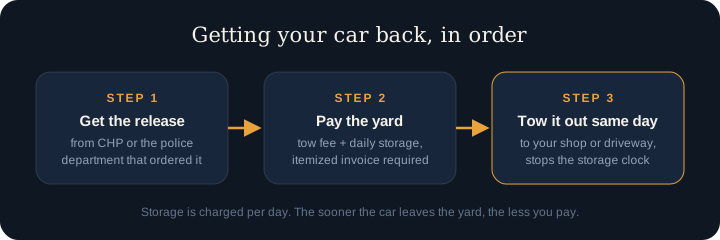
Step 2: Get the release before you go to the yard
This is the step people miss, and it costs them a wasted trip. For most law-enforcement tows, the storage yard cannot hand over the car until the agency that ordered the tow issues a release.
- CHP tows: contact the CHP area office that covers Solano County. Bring your ID, current registration, and proof of insurance. If the vehicle was impounded because of a suspended or unlicensed driver, a licensed driver must be present to drive or arrange transport, and some impounds carry a mandatory hold period.
- Local police tows: the release usually comes from that department’s records division. Same documents: ID, registration, insurance.
- Private lot tows: no police release needed. You deal with the tow company directly, and California law gives you specific rights here, including an itemized invoice.
Step 3: Settle up at the yard, and know your rights
At the storage yard you’ll pay the tow fee plus storage, which is charged per day, often starting the moment the car rolled onto the lot. California law requires the yard to give you an itemized statement of charges, accept at least one form of payment besides cash, and allow you to retrieve personal belongings from the vehicle during business hours even before you pay.
Bring: government ID, proof of ownership (registration or title), insurance, and the release paperwork if law enforcement was involved.
Step 4: Stop the storage clock
Here’s the money-saving move most people don’t know: you don’t have to drive the car out of the yard, you just have to get it out. If the vehicle isn’t drivable after an accident, or your registration situation needs sorting, you can have it towed from the yard to your home, your mechanic, or a body shop the same day you get the release. Storage fees stack daily, and a short yard-to-shop tow almost always costs less than the extra days of storage it prevents.
This matters most after collisions, where cars sit in yards for a week while insurance adjusters schedule inspections. Ask your insurer if the car can be moved to your chosen shop first; most will say yes, and adjusters can inspect it there.
If your car was in an accident
Post-collision tows have their own wrinkles: the car may not be drivable, the other party’s insurance may be involved, and accident recovery to a body shop you trust beats letting it sit. Keep every receipt, tow and storage charges are usually reimbursable on a collision claim.
Need a vehicle moved out of a Solano County yard today? Solano Towing dispatch answers 24/7 at (707) 356-ROAD and can schedule pickup as soon as your release is in hand.