Tule Fog on I-80: How to Drive It Safely
Drivers who move here from almost anywhere else get caught by tule fog exactly once. It is not the thin haze that burns off by nine. It forms overnight on the valley floor, sits in a dense layer only a few hundred feet thick, and can drop visibility on I-80 from clear to nearly nothing inside a single mile. Solano County sits right in it, and the stretch from the Cordelia Junction out across the Suisun Marsh toward the Dixon flats is among the worst of it in the state.
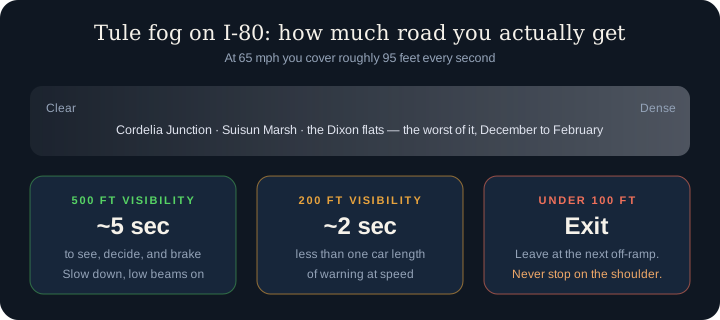
The arithmetic that makes it dangerous
At 65 mph you cover roughly 95 feet every second. That single number explains why fog pileups happen here.
With 500 feet of visibility you get about five seconds between seeing something and reaching it — enough to react if you are paying attention. At 200 feet you are down to roughly two seconds, which is less than the time it takes most drivers to move their foot from the accelerator to the brake and have the car begin slowing. Below 100 feet you are effectively driving blind at freeway speed.
The reason fog crashes on I-80 tend to involve a dozen cars rather than two is that everyone behind you is working with the same two seconds. The first collision is the small one. The pile behind it is the problem.
Low beams, always
The instinct in heavy fog is to switch on the high beams, and it is exactly wrong. Fog is suspended water droplets, and high beams scatter light off them straight back at you — a wall of white glare that makes visibility worse, not better.
Use low beams, and fog lights if the car has them. If you have automatic headlights, check that they actually came on: many systems read daytime fog as daylight and leave the headlights off, which means the car behind you has nothing to see. Your daytime running lights usually do not illuminate your tail lights. Being visible from behind matters more than seeing ahead.
Use the fog line, not the centre line
The white stripe on the right edge of the pavement is called the fog line, and this is what it is for. In heavy fog it is often the only reference you can hold, and it keeps you positioned without drifting.
Watching the centre line instead pulls you toward oncoming or passing traffic, and following the tail lights of the car ahead is the classic way people end up in a pile — you inherit their spacing and their mistakes, and you have no idea what is in front of them.
Do not stop on the shoulder
This is the part people get wrong under pressure. When visibility collapses, the instinct is to pull onto the shoulder and wait it out. On I-80 in dense fog, the shoulder is one of the most dangerous places you can be. Drivers behind you are navigating by whatever lights they can see, and a stationary car on the edge of the road reads as a moving car in the lane. People steer toward it.
If the fog gets worse than you can safely handle, take the next exit and stop somewhere off the freeway entirely — a lit parking lot, a side street. Around here that means Green Valley Road, Suisun Valley Road, Central Way, Travis Boulevard, or the Air Base Parkway exits. Getting off the freeway is worth a twenty-minute delay.
If you genuinely cannot move the car — a breakdown, not a choice — get it as far right as it will roll, hazards on, stay belted inside, and call for help immediately. Tell dispatch it is a fog situation and give your direction of travel plus the last exit you passed. Operators approach a fog call differently: slower, with more warning lights, and positioning the truck to shield the scene.
Before the fog season starts
A few things are worth handling in November rather than discovering in January:
- Wiper blades. Fog condenses on the windscreen constantly. Worn blades smear it into exactly the glare you cannot afford.
- Defroster and climate. Interior fogging is half the problem. Air conditioning dries the air even when you want heat, and it clears the glass faster than heat alone.
- All your lights. Both tail lights, both brake lights. In fog, the driver behind you is relying on them entirely.
- Your battery. The first cold, damp mornings of fog season are also when weak batteries quit, and a dead car in a fog bank is a bad combination.
If traffic stops ahead of you
Do not slam on the brakes and stay put. Brake early and progressively so the driver behind gets more warning, and once you are stopped, keep some space ahead of you rather than closing right up. That gap is your escape route if someone comes in hot from behind.
If a collision has already happened ahead and you are stopped in the lane, getting people out of the vehicle and behind a barrier is usually safer than sitting in a stopped car in a live fog lane — but only if there is somewhere genuinely safe to go. Call 911, then stay aware of what is coming up behind you.
When it clears
Tule fog usually burns off by late morning, and the trap on the back end is patchiness. You come out of a dense bank into clear sun, speed up, and hit another bank a mile later that is just as thick. The Suisun Marsh stretch does this repeatedly. Keep your speed moderate until you are genuinely out of it, which around here often means past Dixon or over the Vaca grade.
Stuck on the corridor in bad weather? Solano Towing dispatch answers 24/7 at (707) 356-ROAD, and operators run this stretch of I-80 every day of the year.