Highway 12 Breakdown: Where to Pull Off
Highway 12 is the road our drivers talk about most. It runs the width of the county in two very different halves: west through Jameson Canyon between the Cordelia Junction and Napa, and east from Suisun City out across the delta to the Rio Vista bridge. Both halves share the same problem. When something goes wrong there, the places to put a car are few and far apart, and most drivers do not know where the next one is.
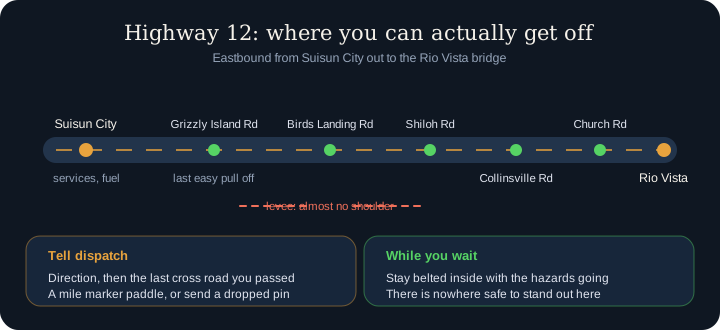
Why this road is unforgiving
Through the delta, Highway 12 is mostly two lanes with a narrow shoulder, and in the levee sections there is barely any shoulder at all, with a drop and water or a drainage ditch immediately beyond it. Traffic moves at highway speed, there are farm vehicles and heavy trucks in the mix, and the gaps between anything resembling a business run for miles.
Add the local weather. Wind comes across the Montezuma Hills hard enough to run a wind farm, which is lively for anything high sided. Winter brings tule fog that can close visibility down to a car length. Summer afternoons run hot with no shade anywhere.
Jameson Canyon, on the west end, is a faster four lane run now, but the shoulder through the canyon is thin and the traffic volume between Solano and Napa counties is heavy all day.
Where you can actually get off
Heading east from Suisun City toward Rio Vista, these are the places with real room, roughly in order:
- The Grizzly Island Road junction. The last easy pull off before the long open run, with room to get a car well clear of the lane.
- Birds Landing Road. A proper intersection out in the hills with space on the corner.
- Shiloh Road and Collinsville Road. Side roads south toward the river, both wide enough at the junction to be out of the traffic stream.
- Church Road and the Highway 113 junction at the Rio Vista end, where you are close to town and to services.
- Rio Vista itself. Once you are across the Highway 113 junction you are into town, with lots, fuel and somewhere to wait indoors.
Going west toward Napa, the honest list is shorter: get back to the Cordelia Junction and the truck stops on Central Way, or continue through to the Napa County line. In the canyon itself, take any wide spot you can find and stay in the car.
If the car is still moving at all, reaching one of these beats stopping where you are. A limping car that makes it to a junction is a safe, ordinary tow. A car stopped on a levee shoulder is a hazard for everyone, yourself included.
Stay in the vehicle
On this road more than any other we cover, stay belted inside with the hazards on.
The temptation is to get out and stand clear, which is the right instinct on a wide freeway shoulder with a barrier. Out here there is nowhere to stand. The ground beyond the pavement is often soft, sloped, or straight into a ditch, and oncoming drivers coming out of a bend or out of fog have very little time to register a person. Your car is a large lit object. You are not.
The exception stays the same everywhere: smoke or fire means get out and get well away.
How to be found
Addresses do not exist out there, so give the dispatcher something a driver can navigate to:
- Direction of travel. Eastbound toward Rio Vista, or westbound toward Suisun.
- The last cross road you passed, by name. This is the single most useful detail.
- A mile marker if you can see one of the small green paddles at the edge of the pavement.
- What you can see. The wind turbines, a bridge, a farm building, the marsh, a sign for a side road ahead. Out there a landmark genuinely narrows it down.
- Which side of the road you are on, since there is no turning around on a levee.
Dropping a pin from your phone and sending it is faster than any description, and worth doing before your battery gets low.
Night, fog and the wind
After dark the delta stretch has no street lighting of any kind. If you are stopped, leave the hazards going and the parking lights on, and if you have a reflective triangle in the trunk, set it well back up the road only if there is a safe place to walk to, which on a levee usually means there is not.
In fog, do not stop on the pavement if there is any way to avoid it. A stationary car in dense tule fog is the classic setup for a chain collision, which is why the advice on driving in tule fog is to leave the road entirely rather than stop on a shoulder. If you have no choice, hazards on, seatbelts on, and call immediately so the responders know you are there.
In high wind, be aware that opening a door against the gusts out there can take it out of your hand, and a trailer parked on a soft shoulder can shift.
What we send
Most Highway 12 calls are ordinary tows that simply take longer to reach. Some are not: cars that slid off into the mud on a wet shoulder need a winch-out, and a stuck truck or trailer in the farm traffic needs heavy duty equipment. Saying which one you are on the phone is what gets the right truck out the first time, instead of a second trip.
We dispatch the full length of the road, from Suisun City out to Rio Vista and the bridge. Stuck out there now? Solano Towing answers 24/7 at (707) 356-ROAD, with a firm price and an honest ETA before a truck rolls.